
The Homemade Campaign
You don’t need permission to build the capacity to win.

We don’t have to depend on national groups or be limited by their decisions. We can build real political capacity where we live. I have been promoting the idea of community-built campaigns for decades. For the last two weeks, I have been working on-site with a local Democratic Committee to put that idea into practice.
From my recent newsletter, The Revolution Will Be LIVE: Top 10 Reasons to Organize in the Real World:
Politics should be people having real conversations with their friends, neighbors, and entire communities about what we need from each other and from our government, and who will best represent us in that government.
To get there, we need to build local political agency: campaign capacity within communities themselves. That is the best strategy for winning elections, defeating the influence of money in politics, and reversing the rising tide of fascism in both our politics and our society.
That newsletter gives 10 reasons why we should campaign this way. This newsletter is about how to actually do it!
Thank you for reading Reframing America! I need your help to continue this critical mission. The best thing you can do is to forward this email to everyone you know who cares about improving how we communicate with the American people.
Where We Are
Campaign strategy is usually based on demographic targeting, bombarding a few voters while ignoring the rest. Democrats, in our over-focus on “data driven decision-making,” frequently end up “running the last campaign.” This is no longer a viable option in a time of rapid and drastic change that includes unprecedented threats from our presidential administration, unaddressed economic discontent, a completely toxic media environment, and a level of disappointment with the Democratic Party status quo that threatens our ability to win elections.
Homemade or community-based campaigns are grounded in a body of research that shows the essential role of in-person word-of-mouth in persuasion and motivation, and the relative lack of effectiveness of targeted print media and paid advertising, especially attack ads.
We start by determining what makes a community unique. We can build campaigns with the people, resources and relationships already in the community, instead of raising a ton of money to influence that community from the outside.
You might ask, “But can it scale up?” Yes. Bigger campaigns can and should be built out of many locally customized and largely autonomous campaigns working together. If you absolutely must standardize parts of the campaign to achieve economies of scale, make sure you don’t damage the relationships and intangible qualities that make homegrown campaigns work.
(Since most issues of this newsletter are about language and messaging, I will not address those specifically here.)
Showing Up
The number one complaint I hear about Democrats is that we “only come around when we want something.” If there is one thing we want people saying about us and our candidates when they talk to their neighbors, it’s that WE SHOWED UP, that we listened, and we fought for them the best we could. In the context of the campaign, this means that we need to do everything we can to actually be present and to give people opportunities to see us being present.
How to Be Everywhere
The “Circulatory System” Model: Every electoral district is made up of many communities, each of which has its own “circulatory system” for the distribution of information. There are physical locations where people gather or points where many people pass through. There are human networkers and super-connectors. There are institutions like churches and schools. There are clubs and groups, lists and newsletters. Our challenge is to find a way to insert ourselves into the natural social and information flow of each community.
Find guides. Seek out people who will vouch for you to their communities, whether that means going with you to knock on doors or inviting you to speak to their group, holding a house party for you, or posting about you in their email lists and Facebook groups.
Go where the people are. Make a map of your community that shows everywhere people physically gather and a calendar that shows when. Your mission is to try to have your candidate, a representative of the campaign, or some form of visibility, present wherever people get together.
Run as a team. Everyone has inroads to different communities. The more people who work together, the wider the range of social groups you can introduce each other to.
Case Study: Maximizing Candidate-Voter Time
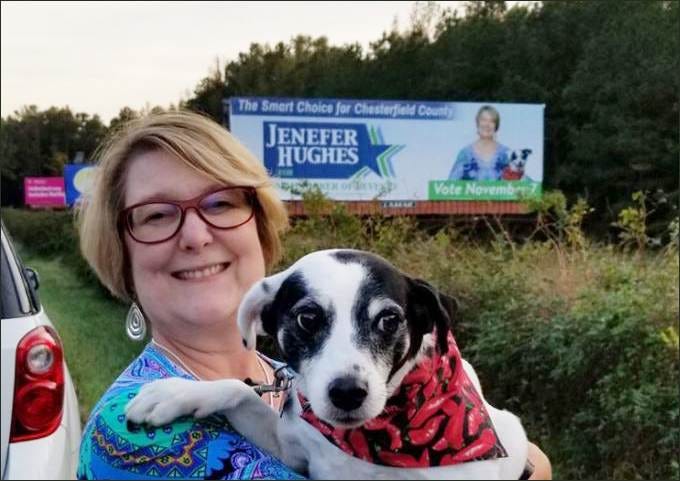
The single most effective means of persuasion is for the candidate to personally ask a voter for their vote. In 2017, I interviewed Jenefer Hughes, a candidate who built an incredibly successful campaign around maximizing this face-to-face time with voters. She limited her budget to highway billboards and hand-out cards. Instead of spending her time on the phone raising money, she spent every possible moment out in the community, showing up anywhere there were a handful or more of people gathering in public.
She went to every church service, baseball game, grocery store, etc. People recognized her from seeing her face on the billboards. She did not even canvass, because she could meet more voters per hour by approaching them in groups. She got the most votes of any candidate on the ballot, just short of 60,000 votes, spending less than a dollar per vote, and remains in office to this day. We can learn from what she did and multiply it through collaboration and amplification on social media.
Familiarity, Authenticity, and Trust
Face Recognition
As Jenefer Hughes’ campaign illustrates, face recognition is a top priority. Get a good picture, one in which you are well lit and looking straight into the camera, one that makes you look warm, friendly and trustworthy. Name recognition alone is not enough. Whether they should or not, people judge by looking you in the eye.
Put this image everywhere you possibly can, from lawn signs to literature. Repeat exposure to your image creates a sense of familiarity and attachment. It literally grows the neural networks in people’s brains that house the idea of you, making them feel subconsciously more favorable toward you.
There is also an incredibly important role for visibility (whether of your name, logo or image) in keeping word-of-mouth alive and growing. Visual cues in the environment prompt people to start conversations and share stories. This is a critical part of how all advertising works.
Social Video
Social video is a way to gain trust, to let viewers get to know us and see us being present in their communities.
Minimally produced, “fourth wall” (eye contact with the viewer) video is swiftly gaining dominance over all other social media formats. As with still images, people can gain clues as to trustworthiness and authenticity from looking you in the eye, seeing your manner and facial expressions, and hearing your tone of voice.
The age of limiting and controlling your exposure is over. It’s all about volume now. Social media stars and politicians gain a following by producing endless hours of unscripted and even unedited content. Audiences trust people like Joe Rogan, not because he is always right, but because they know him from thousands of hours of hearing him carry on.
This creates an opportunity for us in the political space. We can produce video addressing every topic we care about, so long as we do it authentically, from the heart. No polling. No packaging. Just be yourself.
There is a simple way to avoid going viral for the wrong reasons: be positive and don’t fall for trick questions. Whenever a politician says something that gets turned into an attack ad, it is because they are either being snarky or defensive.
Use social video to show you being present in the community. Zorhan Mamdani used this strategy with great effect in his campaign. If people see you on video somewhere they have been or where they regularly go, it anchors your existence in their reality. They feel like you are physically present in their world, even if you are not both there at the same time.
Tangible Visibility: Lawn Signs and Postcards
Getting our base to turn out is necessary, but no longer sufficient. In addition to the above, here is an effective way to increase turnout with very limited resources. Social media and text messages are virtual and vanish after moments. Lawn signs and postcards are tangible; they have a longer lasting presence in the physical world.
Lawn Signs: Use registration and previous election data to identify strong Democratic voters and then plot them on a map. Identify nodes of greatest geographic concentration. Our goal should be to achieve saturation-level visibility in these areas using lawn signs on residential properties (and billboards where possible) to build name/face recognition and demonstrate peer support. Use QR codes to drive people to follow-up information.
GOTV Postcards: Mobilize volunteers to write and send postcards to Democratic voters, encouraging them to vote. They need to be authentic and personal. Use postcards that appear to be purchased off-the-shelf and messages that are hand-written, values-based and positive. Research shows that this type of postcard can increase turnout by 2.37 points.
GOTV Signs: In order to generate turnout, we should do a second series of lawn signs and even hand-held signs to tell people that early voting has started, or that election day is coming, etc. These should be designed to appear non-partisan and informative. In one study, hand-held signs increased turnout by 3.48 percentage points.
The Bottom Line
We have to show up in communities and listen to individual people, and do it regularly, not just during the election cycle. It may not seem like this could reach enough people in enough time, but the reality is that when you really show up in people’s lives, the word gets around.
If people work together, to represent each other, to introduce each other to the communities in which they live and with whom they have developed trust, we can multiply this effect of personal connection. You build that on top of the familiarity you gain by having your face and name appear everywhere and expressing yourself authentically in video.
This will create the sense that you, collectively, are not just present but everywhere in the community.

Thank you so much for reading this. I hope it is of use to you in your work and activism!
In solidarity, always,


My work is completely financed by subscribers like you! All content is free, but many people choose to upgrade to a paying subscription to help support this work!
USE THIS LINK to upgrade from the app!
Contact me at antonia@antoniascatton.com or (202) 922-6647
"The single most effective means of persuasion is for the candidate to personally ask a voter for their vote."
^I had no idea! I have literally never been personally asked for a vote, not even in school, it was always addressed to a group I was in. This makes so much sense though! Especially for local elections I really wish campaigns would prioritize this more!
So glad to see someone advocating relationships and community instead of data-guessing. You also seem to be advocating that candidates know how they want to change the world and work to create that reality instead of chasing the world we find ourselves in created by the think-tanks and influencers.